"Replaced controller, $280" tells your customer nothing about why. A good repair report shows what you measured, what you found and how you know, so the customer trusts the bill, your technicians record repairs the same way, and you have a record when the bike comes back. Here is what to include, and a template you can copy.
Why a written report pays off
- Customers approve work faster when they can see the readings behind a recommendation.
- Fewer disputes. If a battery fails again in three months, you have the readings from the first visit.
- Consistent work across technicians. Everyone follows the same steps and records the same things.
- Warranty and service partners increasingly ask for evidence, not just a part number.
What every report should contain
Here is a finished report for a sample job, with notes on each part. The sections below explain them one by one.
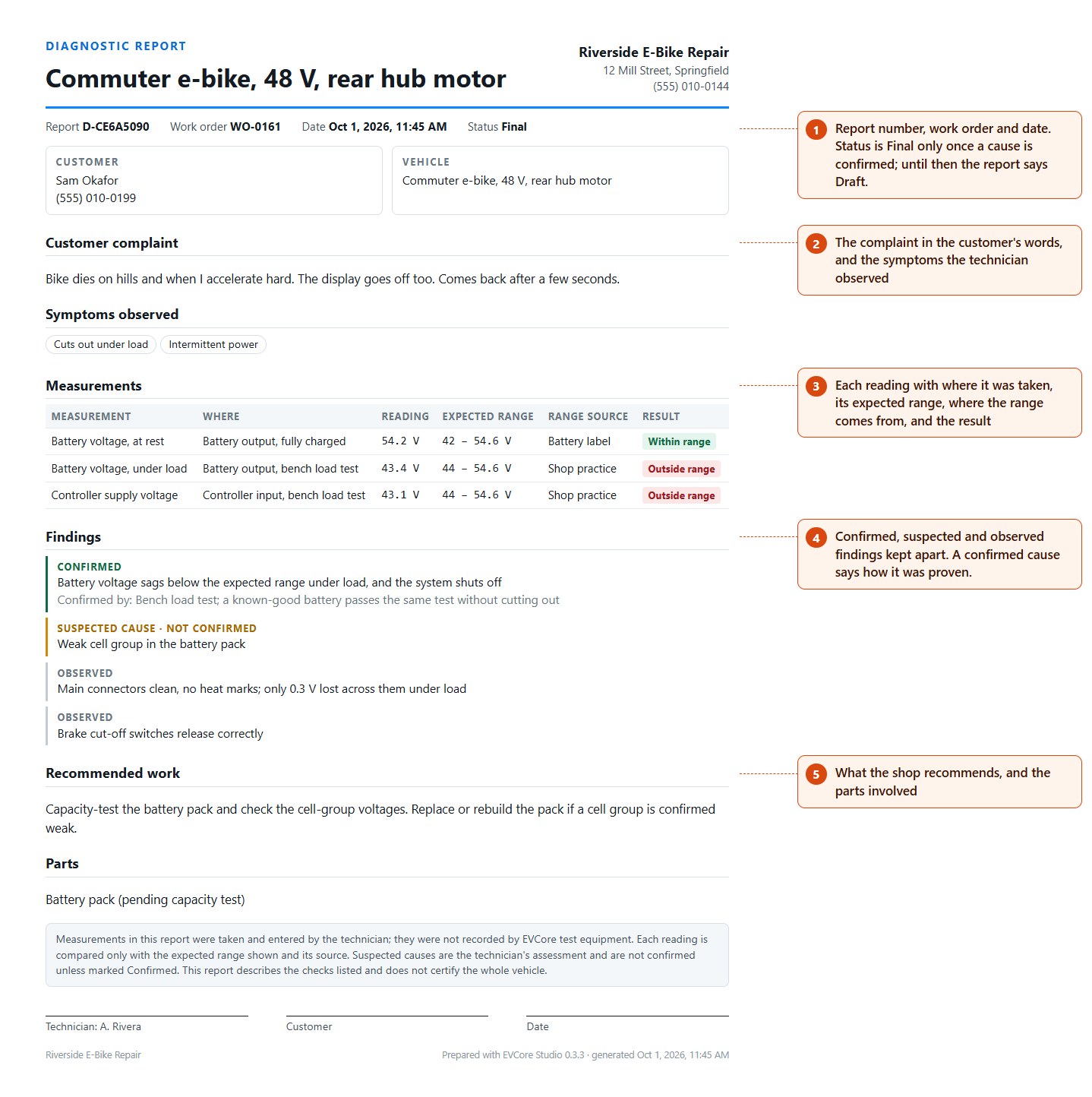
A diagnostic report produced by EVCore Studio for a sample job. The shop, customer and readings are examples.
1. Shop, customer and vehicle
Your shop name and contact details, the date, the work order number, the customer's name, and the vehicle: make, model, and the serial numbers of the frame, battery, motor and controller where you can read them. Serial numbers make the history of that bike traceable.
2. The complaint, in the customer's words
Write it as they said it: "cuts out on hills, comes back after a few seconds". Add the symptoms you observed yourself, separately.
3. Measurements, each with its expected range and source
This is the part most reports leave out, and the part that builds trust. For every reading, record:
| Measurement | Where | Reading | Expected range | Range source |
|---|---|---|---|---|
| Battery voltage, at rest | Battery output, fully charged | 54.2 V | 42 to 54.6 V | Battery label |
| Controller supply voltage | Controller input, bench load test | 43.1 V | 44 to 54.6 V | Shop practice |
The range source matters: a reading is only meaningful against a range, and the range is only trustworthy if you say where it came from (the battery label, the manufacturer's service manual, a component datasheet, or your shop's own documented practice). Also note the conditions: state of charge, temperature and load.
4. Findings, clearly graded
Keep three kinds of finding apart:
- Observed: something you saw or measured ("throttle output within range").
- Suspected: a likely cause you have not proven yet ("weak cell group in the battery").
- Confirmed: a cause you proved, with how you proved it ("voltage sag confirmed on a load test; fault gone with a known-good battery").
Never present a suspicion as a confirmed fault. If nothing is confirmed yet, say so and mark the report as a draft.
5. Recommended work and parts
What you recommend, the parts involved, and anything the customer should know (for example, "battery capacity test recommended before replacing the pack").
6. Technician and sign-off
Who did the work, and when the report was finalized.
The template
Copy this into your shop's document or invoice system:
REPAIR REPORT                         Work order: ______  Date: ______
Shop: ______________________  Phone: __________  Email: ____________

Customer: __________________  Phone/email: ________________________
Vehicle: ___________________  Frame/battery/motor/controller serials:
_____________________________________________________________________

Customer's complaint:
_____________________________________________________________________
Symptoms observed:
_____________________________________________________________________

Measurements
Measurement | Where | Reading | Expected range | Range source | Result
____________|_______|_________|________________|______________|_______
____________|_______|_________|________________|______________|_______

Findings
[ ] Observed:  ______________________________________________________
[ ] Suspected: ______________________________________________________
[ ] Confirmed: ____________________  How confirmed: _________________

Recommended work: ____________________________________________________
Parts: _______________________________________________________________
Technician: ________________  Status: [ ] Draft  [ ] Final
Make it automatic
Filling this in by hand works, but it is easy to skip a column on a busy day. EVCore Studio records the complaint, each measurement with its expected range and source, and findings graded as observed, suspected or confirmed, then turns them into a PDF report with your shop's details. The report is marked final only once a finding is confirmed, and draft until then. You can see a sample report in the two-minute guided demo, or see pricing.